

Mwalimu National DT Sacco: Everything You Need to Know About Membership, Loans, Savings, Dividends and FOSA Services.
Table of Contents
- What is Mwalimu National DT Sacco?
- History of Mwalimu National DT Sacco
- Membership Requirements and Who Can Join
- How to Join Mwalimu National Sacco
- Share Capital and Monthly Deposits
- Savings Products
- Loan Products (BOSA and FOSA)
- FOSA Services
- Mobile and Digital Banking
- Dividends and Interest on Deposits (2025 Results)
- The Spire Bank Legacy: What Members Should Know
- Loan Requirements and Guarantorship
- Branch Network
- Leadership and Governance
- Customer Care Contacts
- Recent Developments and Achievements
- Frequently Asked Questions
1. What is Mwalimu National DT Sacco?
Mwalimu National Deposit Taking Savings and Credit Co-operative Society Limited — commonly called Mwalimu National Sacco or simply Mwalimu Sacco — is Kenya’s largest deposit-taking Sacco by total assets, and one of the largest financial cooperatives in Africa. It was established primarily to serve teachers employed by the Teachers Service Commission (TSC), though its membership base has expanded significantly in recent years to include other salaried employees, self-employed Kenyans, SMEs, and the diaspora.
The Sacco is regulated by the Sacco Societies Regulatory Authority (SASRA) and is affiliated with the Kenya Union of Savings and Credit Co-operatives (KUSCCO), the African Confederation of Co-operative Savings and Credit Associations (ACCOSCA), and the World Council of Credit Unions (WOCCU). Its headquarters, Mwalimu Towers, sits on Hill Lane off Mara Road in Upper Hill, Nairobi.
As of the 2025 financial year, Mwalimu National reported total assets of approximately KSh 76.3 billion, cementing its position as Kenya’s biggest Sacco by that measure.
2. History of Mwalimu National DT Sacco
Mwalimu National was founded in 1974 under the Co-operative Societies Act, registered as CS/2265, with a small founding membership (widely cited as between 9 and 11 members) drawn from the teaching profession. Its original purpose was to mobilise teachers’ savings and provide them with affordable financial services, at a time when teachers had limited access to formal banking.
The Sacco’s early operations were based at Development House before it relocated in 1984 to Tom Mboya Street, into what became known as Mwalimu Co-op House. As the Sacco grew, it later acquired land in Upper Hill, Nairobi, where it built its current headquarters, Mwalimu Towers.
Its philosophy, reflected in its tagline “We are who we are because a teacher believed in us,” positions the Sacco as an institution built by, and for, Kenya’s educators. Over five decades it grew from a small teachers’ thrift group into a systemically significant financial institution whose asset base rivals several mid-tier commercial banks.
A major turning point came in 2023, when Mwalimu National officially opened its common bond, allowing it to admit members beyond the teaching profession — including civil servants, county government workers, private-sector professionals, SMEs, and Kenyans in the diaspora — while still keeping teachers as its core constituency.
3. Membership Requirements and Who Can Join
Mwalimu National organises membership into two broad classes:
Class A (main membership category) generally includes:
- TSC-employed teachers (post-primary, TVET, and secretariat staff)
- Primary school teachers holding at least a diploma
- University lecturers
- Spouses and adult children (18+) of existing members who are themselves formally employed
- Former TSC/education-sector employees now working in other formal employment or running businesses
- Certain Board of Management (BOM) teachers with a diploma or higher
- The board retains discretion to admit some primary teachers below diploma level on merit
Class B covers education students at diploma or degree level, and certain categories of previously withdrawn members.
Since the 2023 opening of its common bond, the Sacco has actively expanded beyond teaching staff — including formal partnerships (see Section 16) aimed at bringing in SMEs, informal-sector traders, and businesses.
4. How to Join Mwalimu National Sacco
The general process for joining is:
- Obtain a membership application form — available at any branch or via the Sacco’s official website/members portal.
- Confirm you meet the eligibility criteria for the relevant membership class.
- Complete the form and gather supporting documents (see checklist below).
- Submit the application at a branch or through the Sacco’s digital channels, along with the required entrance fee.
- Purchase the minimum required share capital.
- Begin your monthly contributions, typically through payroll check-off (for TSC/salaried employees) or standing order/mobile payment (for other categories).
Membership Documents Checklist
- National ID or passport
- KRA PIN certificate
- Passport-size photographs
- Employment letter or recent payslip (where applicable)
- Bank account details
- Next-of-kin information
Because minimum share capital, entrance fees, and specific document requirements are periodically revised, prospective members should confirm current figures directly with the Sacco before applying.
5. Share Capital and Monthly Deposits
Members are required to hold a minimum share capital (a one-off ownership stake in the Sacco, which earns dividends) as well as make ongoing monthly deposits/savings, which earn interest and form the basis for loan eligibility.
- Share capital represents your ownership stake in the Sacco and determines your dividend earnings.
- Deposits/savings are your regular contributions, which grow your borrowing capacity (most BOSA loan products are calculated as a multiple of a member’s deposits) and earn annual interest.
Consistent, regular contributions are central to how Mwalimu National calculates loan eligibility, since most loan limits are pegged to a multiple of a member’s accumulated deposits, subject to affordability (the “one-third of net salary” rule common across Kenyan Saccos).
6. Savings Products
Mwalimu National offers a range of savings options designed around different member needs, including:
- Ordinary/BOSA savings — the core savings account underpinning loan eligibility
- Fixed deposit accounts — for members looking to lock in savings at a set return
- Junior/children’s savings accounts — for members saving on behalf of dependents
- Holiday and school-fees-oriented savings products
- Diaspora savings accounts — for members based outside Kenya
In November 2025, the Sacco also launched Mualim, a Sharia-compliant savings and financing window based on Islamic finance principles (profit-sharing/Mudharabah rather than interest), open to all members regardless of faith. Mualim products reportedly include Hajj savings, junior savings, holiday/Eid savings, and home-finance options, though it typically requires a higher minimum share capital than conventional accounts.
7. Loan Products (BOSA and FOSA)
Mwalimu National’s lending is organised under two arms: Back Office Service Activities (BOSA), which lends against a member’s deposits, and Front Office Service Activities (FOSA), which offers bank-like products including salary-linked and instant loans.
Selected BOSA Loan Products
- Development Loan — for long-term investment purposes, typically repayable over an extended period (reported terms of up to 84 months), with the loan limit generally calculated as a multiple of a member’s deposits (subject to the one-third salary rule).
- Emergency Loan — for unforeseen circumstances, generally repayable within 12–24 months, drawn against a member’s entitlement/deposits.
- School Fees Loan — for education-related expenses, typically repayable over about 24 months.
- Vision Loan (e.g., “Vision 84”) — a longer-term development-style product, historically priced around 1.29% per month on a reducing balance.
- Wezesha Loan — designed specifically for new members. Unlike other products, it does not require the usual multi-month waiting period; new members can access funds (historically up to around KSh 600,000, fully guaranteed) as soon as their first savings deduction clears, with roughly a third of the amount retained as savings. Rates have been quoted around 13% per annum on a reducing balance.
- Asset Financing / Motorcycle Loans — for financing vehicles or equipment.
- Group loans — tiered products for members organised in self-help or investment groups.
- Individual business loans — including the newer informal-sector/SME lending line introduced through the 2026 KNCCI partnership (see Section 16), reported at a preferential rate around 12% for qualifying informal-sector borrowers.
Selected FOSA Loan Products
- Salary advance / M-Loan — a short-term mobile-accessible loan for members whose salaries or savings run through FOSA/SAYE accounts; the M-Loan rate has been revised over time (quoted historically around 4% per month).
- New-employee/intern loans — targeted at newly employed TSC teachers and interns, historically disbursed in tranches (e.g., up to roughly KSh 60,000 for new teachers and KSh 30,000 for interns, paid over several monthly instalments with a grace period before repayment begins).
Important: Loan products, limits, interest rates, and multipliers are revised periodically by the Sacco’s board and AGM. The figures above reflect recently reported terms and should be confirmed against the Sacco’s current official rate card before applying.
8. FOSA Services
Mwalimu National’s Front Office Service Activity (FOSA) functions much like a bank branch and offers:
- Salary processing and payroll-linked accounts (including the new Salo Xpress payroll solution developed with NCBA Bank — see Section 16)
- Savings and current accounts
- Standing orders and internal fund transfers
- Utility bill payments
- Loan disbursement and repayment services
- Debit/ATM card access at participating outlets
9. Mobile and Digital Banking
Members can access accounts remotely through:
- Go-Mobile / Mhela App — the Sacco’s mobile banking application, available for Android and iOS, supporting balance enquiries, mini-statements, funds transfers, and loan applications.
- USSD banking via short codes (members should confirm the current active code, historically publicised as 28651# and *633#, with the Sacco periodically updating these).
- Members Portal (membersportal.mwalimunational.coop) — for statements, loan applications, dividend information, and account management online.
- Paybill 541900 for deposits and payments.
- SMS banking (short code 20156) for balance and service enquiries.
Registration for mobile/digital services is typically done at the nearest branch, where members are issued a username and M-PIN, which should be changed on first use.
10. Dividends and Interest on Deposits (2025 Results)
For the financial year ended 31 December 2025, Mwalimu National posted some of its strongest results in years:
- Total assets: grew to approximately KSh 76.3 billion, up from KSh 68.9 billion in 2024
- Loans and advances: rose to about KSh 56.3 billion, up 19.3% from KSh 47.2 billion in 2024
- Member deposits: closed at roughly KSh 56.5 billion, up from KSh 52.2 billion
- Net surplus: jumped 76.3% to about KSh 1.27 billion, from KSh 718.9 million in 2024 — its strongest showing since 2020
- Net interest income: rose 11% to about KSh 3.53 billion
- Total equity: grew 13.7% to roughly KSh 11.4 billion
- Dividend on member share capital: held at 13%, unchanged from 2024
- Interest on member deposits: rose slightly to 10.05%, from 10.00% in 2024
For context, dividend rates vary widely across Kenyan Saccos each year, and several peer Saccos declared higher rates on smaller asset bases in the same season (for example, some Saccos in the mid-teens to high-teens percentage range for 2025). Mwalimu’s leadership has attributed the decision to hold dividends steady, despite the surplus jump, partly to the need to retain capital while working through its Spire Bank capital restoration plan (see next section).
Dividend and interest rates are declared annually at the Sacco’s Annual Delegates Meeting (ADM) and can change year to year — always confirm the latest declared rate directly with the Sacco or through official AGM communications before relying on any figure for financial planning.
11. The Spire Bank Legacy: What Members Should Know
A significant, often under-reported part of Mwalimu National’s recent history involves its investment in Spire Bank (formerly Equatorial Commercial Bank), and members researching the Sacco’s finances should understand this context.
Starting in 2015, Mwalimu National invested more than KSh 13 billion of members’ savings to acquire and grow Spire Bank as part of a strategy to diversify into commercial banking. The venture struggled with sustained losses and capital shortfalls. Businessman Naushad Merali, an early co-investor, withdrew roughly KSh 1.7 billion in deposits in 2016 after selling his shares, a move the Sacco’s board later blamed in part for the bank’s decline.
In September 2022, Equity Bank agreed to acquire a portion of Spire Bank’s loans and deposits, a deal concluded in February 2023 that brought roughly 20,000 depositors and 3,700 loan customers under Equity Bank. The Central Bank of Kenya subsequently granted conditional approval for Spire Bank’s eventual liquidation.
Rather than force Mwalimu National to absorb the full remaining loss at once — which risked compromising its capital adequacy — SASRA, in consultation with the Ministry of Co-operatives, approved a structured six-year capital deficiency restoration plan (2022–2027), allowing the Sacco to gradually write off the roughly KSh 8 billion investment. Cumulative losses tied to the Spire Bank venture have been estimated at around KSh 7.7 billion by independent analysts.
As part of this plan, Mwalimu National booked a KSh 960.3 million net impairment charge in its 2025 accounts tied to Spire Bank, even as it posted record profit growth. The Sacco faces its single largest scheduled write-off of about KSh 1.70 billion in 2026 under the restoration plan. This write-down has previously pushed the Sacco’s institutional capital ratio below SASRA’s required 8% threshold, a matter regulators continue to monitor closely.
What this means for members: the Spire Bank losses do not represent money missing from individual member accounts, but they have constrained how much surplus the Sacco can allocate to dividends versus retained capital in recent years, and they explain why capital adequacy has been a recurring regulatory talking point for Mwalimu National since 2023–2024.
12. Loan Requirements and Guarantorship
General requirements to qualify for most Mwalimu National loan products include:
- Active, continuous membership for a minimum period specified by Sacco by-laws
- Sufficient accumulated savings/deposits (since most limits are calculated as a multiple of deposits)
- Adequate guarantors, depending on the loan amount and product
- Demonstrated ability to repay, generally assessed against the “one-third of net salary” affordability rule
- A satisfactory credit history/no default record
- Complete supporting documentation (ID, payslip, and relevant application forms)
On guarantorship: guarantors are typically fellow Sacco members who commit to covering a borrower’s outstanding balance if the borrower defaults. This means a guarantor’s own borrowing capacity can be reduced while they are guaranteeing another member’s loan. Guarantors generally have the right to be released from their obligation once the guaranteed loan is fully repaid, or, in some cases, if the borrower secures a replacement guarantor. Anyone considering guaranteeing a loan should fully understand this shared liability before committing.
13. Branch Network
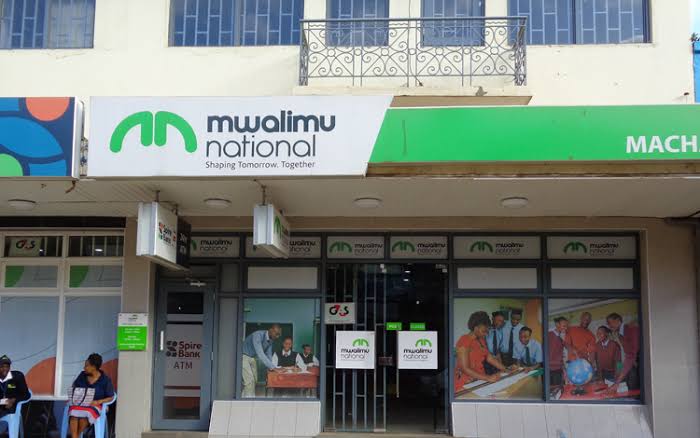
Mwalimu National maintains an extensive nationwide network of over 20 branches, including its Head Office (Mwalimu Towers, Upper Hill, Nairobi) and outlets in locations such as Nairobi CBD (Tom Mboya Street), Mombasa, Kisumu, Nakuru, Eldoret, Kakamega, Kisii, Nyeri, Meru, Embu, Kitui, Machakos, Thika, Homa Bay, Migori, Siaya, Narok, Nyahururu, Kapenguria, Voi, Lodwar, Webuye, Mwingi, Litein, and TSC headquarters-based service points, among others.
Because branch locations, operating hours, and services occasionally change, members should confirm current details through the official Mwalimu National website or customer care before visiting.
14. Leadership and Governance
As of mid-2026, Mwalimu National’s leadership includes:
- Board Chairman: Joel Gachari
- Chief Executive Officer: Kenneth Odhiambo
- Other board members drawn from across the Sacco’s membership regions
The Sacco is governed by an elected board accountable to members through the Annual Delegates Meeting (ADM), and is supervised externally by SASRA. Sacco leadership has publicly emphasised that, as a member-owned cooperative, investment decisions rest with the Sacco’s own governance structures rather than government direction — a point CEO Kenneth Odhiambo made in July 2026 amid broader public debate over proposed Sacco sector legislation.
15. Customer Care Contacts
- Website: www.mwalimunational.coop
- Head Office: Mwalimu Towers, Hill Lane, Off Mara Road, Upper Hill, Nairobi
- Postal address: P.O. Box 62641–00200, Nairobi
- Telephone: +254 020 295 6000
- Mobile: +254 709 898 000
- SMS line: 20156
- Email: [email protected]
- Members Portal: membersportal.mwalimunational.coop
Members are encouraged to verify contact details periodically via the official website, since phone lines, paybill numbers, and digital channels are occasionally updated (the Sacco announced updated paybill/account numbers in 2026).
16. Recent Developments and Achievements
- KNCCI partnership (May 2026): Mwalimu National signed a Memorandum of Understanding with the Kenya National Chamber of Commerce and Industry to extend affordable credit — reportedly from as low as 12% — to SMEs and the informal sector, part of a deliberate strategy to diversify membership beyond teaching, which Chairman Joel Gachari said was first mooted around 2023 when the Sacco opened its common bond.
- NCBA payroll partnership / Salo Xpress (June 2026): A partnership with NCBA Bank Kenya launched “Salo Xpress,” a payroll management solution aimed at institutions and businesses, reflecting the Sacco’s push into services beyond its traditional teacher base.
- Mualim Sharia-compliant window (November 2025): Launched to offer ethical, interest-free financial products to members of all faiths.
- Housing scheme pilot: Mwalimu National is piloting a housing project (reported as including the Kisaju development) offering apartments and maisonettes to members.
- Ushirika Day recognition: The Sacco has received award recognition at Ushirika Day, Kenya’s national cooperative movement celebration.
- Sector-wide governance debate (July 2026): Amid public concern over the proposed Sacco Societies (Amendment) Bill 2025 and speculation about government access to Sacco assets, Mwalimu National’s CEO was among cooperative-sector leaders who publicly clarified that Sacco funds remain under member and board control, not government direction.
Frequently Asked Questions
Who can join Mwalimu National Sacco? Primarily TSC-employed teachers and education-sector professionals, but since the Sacco opened its common bond in 2023, membership has expanded to include other salaried employees, self-employed Kenyans, SMEs, informal-sector traders, and the diaspora, subject to eligibility criteria.
Is membership limited to teachers? No longer exclusively. While teachers remain the core and majority membership base, the Sacco has actively diversified since 2023 through partnerships aimed at onboarding non-teaching members, including businesses and informal-sector workers.
How much is the minimum monthly contribution? This is set and periodically revised by the Sacco’s board/by-laws; prospective and current members should confirm the current minimum share capital and deposit requirements directly with Mwalimu National.
How do I apply for a loan? Loan applications can be made at a branch or through the Sacco’s digital channels (members portal, mobile app, or USSD), and generally require active membership, sufficient savings, guarantors (where applicable), and supporting documents.
How long must I be a member before qualifying for a loan? Minimum membership periods vary by loan product and are set out in the Sacco’s by-laws; some products, like the Wezesha Loan, are specifically designed to give new members faster access to funds without the standard waiting period.
What happens if my guarantor leaves the Sacco? Guarantor arrangements are governed by Sacco rules; a guarantor generally remains liable for a guaranteed loan until it is repaid or a replacement guarantor is approved, regardless of their own membership status, so members should clarify specific terms with the Sacco.
How are dividends calculated? Dividends are paid annually on members’ share capital, at a rate declared by the Sacco’s board and approved at the Annual Delegates Meeting, based on the Sacco’s surplus for that financial year. For 2025, the rate was held at 13%.
Does Mwalimu National Sacco offer mobile banking? Yes — through its mobile app (Go-Mobile/Mhela App), USSD banking, and SMS banking, alongside an online members portal.
Can retired teachers remain members? Sacco membership is generally not automatically terminated by retirement; retired members are typically permitted to keep their accounts, deposits, and share capital, subject to the Sacco’s specific by-laws — retirees should confirm their status directly with the Sacco.
How do I withdraw my savings? Withdrawal processes depend on the specific product (ordinary deposits vs. fixed deposits vs. share capital) and Sacco rules; members should check current withdrawal procedures and any applicable notice periods through the members portal or a branch.
Where is the head office located? Mwalimu Towers, Hill Lane, Off Mara Road, Upper Hill, Nairobi.
How do I contact customer care? Via telephone (+254 020 295 6000 / +254 709 898 000), SMS (20156), email ([email protected]), or through the official website, www.mwalimunational.coop.
Read Also: Wilson Sossion Profile: Education, Age, Career, Family, KNUT
Is Mwalimu National Sacco financially safe given the Spire Bank losses? The Spire Bank write-offs affected the Sacco’s institutional capital ratios and required a multi-year regulatory restoration plan (2022–2027), but the Sacco has continued to grow assets, deposits, and profitability throughout this period, and remains under active SASRA supervision. As with any financial institution, members with specific concerns should review the Sacco’s published audited accounts and speak to Sacco management directly.
Mwalimu National DT Sacco: Everything You Need to Know About Membership, Loans, Savings, Dividends and FOSA Services.
